
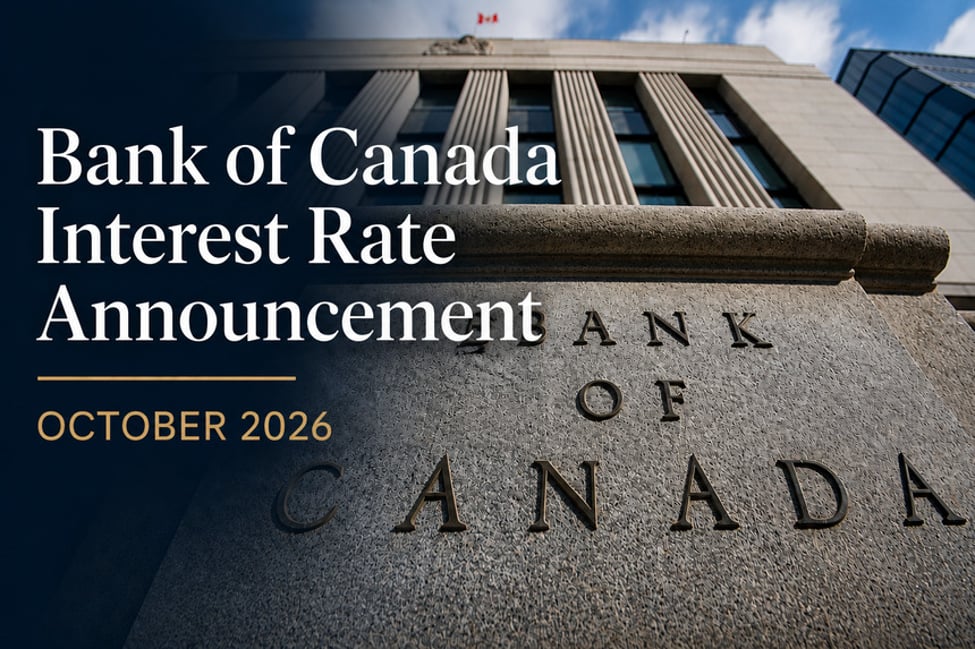
Bank of Canada Raises Interest Rate to 2.50%: What It Means for Toronto Real Estate
October 2026 | Toronto & GTA Housing Market Update
The Bank of Canada has raised its key interest rate for the first time since July 2023, bringing the target for the overnight rate to 2.50% following a 0.25 percentage point increase.
For homeowners, buyers and sellers across Toronto and the Greater Toronto Area (GTA), the announcement raises an important question: What does this mean for my real estate plans?
Interest rates influence mortgage affordability, buyer confidence and housing market activity. But a change in the Bank of Canada's policy rate doesn't affect everyone equally — and it doesn't automatically determine where home prices are headed.
Let's look at why the Bank made this decision, how it could affect the GTA housing market and what you should consider before making your next move.
Why Did the Bank of Canada Raise Interest Rates?
The Bank's October 2026 decision reflects a familiar challenge: balancing economic growth with inflation.
Canada's economy has performed better than previously expected. According to the Bank's October outlook, economic growth strengthened during the second quarter, supported by consumer spending, business investment and exports.
However, inflation remains a concern.
Inflation Is Still Putting Pressure on Household Budgets
Annual inflation has remained around 3% since April, with higher gasoline and energy prices playing a significant role.
The concern isn't limited to what Canadians pay at the pump.
When fuel and transportation become more expensive, businesses may face higher costs to manufacture, transport and deliver goods. Some of those costs can eventually reach consumers.
The Bank expects inflation to remain elevated before gradually returning toward its 2% target around the middle of 2028.
The Economy Is Improving, but Uncertainty Remains
Canada's unemployment rate has remained around 6.5%, suggesting that the labour market still has some softness.
Trade uncertainty, including new U.S. tariffs, also presents challenges for Canadian businesses.
In other words, the economy is showing encouraging signs, but the Bank remains concerned that inflation could become more persistent.
The rate increase is intended to help contain those pressures.
What Does the Rate Increase Mean for Toronto Homebuyers?
For anyone considering buying a home in Toronto, Scarborough or Durham Region, mortgage affordability remains one of the most important considerations.
Your Mortgage Type Makes a Difference
The Bank of Canada's overnight rate influences the interest rates lenders charge, but different mortgage products respond differently.
Variable-rate mortgages are generally tied to a lender's prime rate. If prime rates rise, borrowers may experience higher payments or a change in how much of each payment goes toward interest, depending on their mortgage terms.
Fixed-rate mortgages are influenced more directly by bond yields and financial market expectations. They do not necessarily increase by the same amount as the Bank's policy rate.
That's why a 0.25 percentage point increase doesn't automatically mean every mortgage rate rises by 0.25 percentage points.
How Much Could a Small Rate Increase Affect Payments?
Consider a hypothetical mortgage with a $500,000 balance, a 25-year amortization and monthly payments.
At an illustrative interest rate of 4.00%, the payment would be approximately $2,630 per month.
At 4.25%, it would be approximately $2,697 per month.
That's roughly $67 more each month, or about $800 annually.
This example isn't a prediction of available mortgage rates or an estimate of what every borrower will pay. It simply illustrates why even relatively small changes deserve attention.
Should Buyers Wait for Interest Rates to Fall?
It's tempting to postpone a purchase until borrowing costs improve.
But timing the housing market involves more than watching interest rates.
A lower mortgage rate could improve affordability. However, if lower rates encourage more buyers to return to the market, competition for desirable properties could also increase.
On the other hand, waiting may be sensible if you need more time to save, strengthen your finances or understand your long-term housing needs.
Before shopping for a home, consider obtaining a mortgage pre-approval, reviewing your comfortable monthly budget and discussing different financing scenarios with a qualified mortgage professional.
The best time to buy isn't necessarily when rates reach their lowest point. It's when the property, financing and timing make sense for your circumstances.
What Does the Bank of Canada's Decision Mean for Home Sellers?
Higher borrowing costs can affect how much buyers qualify to borrow and how confidently they approach a purchase.
For sellers, this makes a thoughtful pricing and marketing strategy particularly important.
Pricing Should Reflect Today's Market
A home is ultimately competing with other available properties, not just with homes that sold several months ago.
Recent comparable sales, active listings, property condition and neighbourhood demand all influence how buyers perceive value.
An asking price based on outdated expectations can make it harder to attract serious interest.
Presentation Still Matters
Buyers who have several properties to choose from may pay closer attention to condition, layout, maintenance and overall value.
Professional photography, thoughtful staging, accurate property information and a strong digital marketing strategy can help a listing stand out.
Negotiation Requires Local Knowledge
Market conditions vary by property type and neighbourhood.
A well-maintained detached home in a desirable area may attract different interest than a condominium competing with several similar units.
Understanding local inventory, recent sales and buyer behaviour helps sellers make informed decisions about offers, conditions and timing.
The Bank of Canada's announcement matters, but your property's local market matters just as much.
How Could Higher Interest Rates Affect the GTA Housing Market?
The Greater Toronto Area isn't one single housing market.
Different communities, housing types and price ranges respond to economic changes in different ways.
Toronto and East York
Buyers considering established Toronto and East York neighbourhoods often weigh location, transit access, property condition and long-term lifestyle needs.
Borrowing costs can influence budgets, but the number of comparable homes available is also important.
Scarborough
Scarborough offers a diverse mix of detached homes, townhouses and condominiums.
In neighbourhoods such as Birch Cliff, Cliffcrest, Kennedy Park and surrounding communities, pricing and competition can differ considerably even within a relatively small geographic area.
For condominium owners, building-specific sales, maintenance fees, amenities and available inventory deserve particular attention.
Durham Region: Pickering, Ajax, Whitby and Oshawa
Buyers exploring Durham Region may be comparing additional living space, commuting options and overall monthly ownership costs.
A change in mortgage affordability can influence which property types and price ranges are realistic.
However, conditions in Pickering may not match those in Oshawa, and a detached home may face a different competitive environment than a townhouse or condominium.
That's why local market data is more useful than assuming a national interest rate announcement will affect every GTA neighbourhood in the same way.
What About Homeowners Renewing Their Mortgages?
For homeowners approaching renewal, the key question is how current mortgage offers compare with the rate and terms of their existing mortgage.
Some borrowers may face higher payments, while others may find more favourable options depending on when their current mortgage began.
It's worth reviewing renewal dates early, comparing available options and considering how a potential payment change would fit into your household budget.
Homeowners with variable-rate mortgages or home equity lines of credit should also understand how their lending terms respond to changes in prime rates.
A mortgage broker or lender can explain the available products, qualification requirements and implications of switching lenders or changing terms.
What Should GTA Real Estate Investors Consider?
For investors, financing costs are only one part of the calculation.
Mortgage payments, condominium fees, property taxes, insurance, maintenance, vacancy periods and rental income all affect a property's financial performance.
A higher borrowing rate can reduce monthly cash flow, particularly on highly financed properties.
Before purchasing, investors should test whether the numbers remain manageable under different interest-rate, expense and vacancy scenarios.
The same principle applies to existing investment properties approaching mortgage renewal.
Looking Ahead: Will the Bank of Canada Raise Rates Again?
The Bank of Canada's next scheduled interest rate announcement is December 9, 2026.
Future decisions will depend on how the economy develops.
If inflation remains elevated, the Bank may need to maintain tighter monetary policy or consider additional increases.
If inflation eases and economic activity weakens, the outlook could change.
Employment trends, consumer spending, energy prices and international trade developments will all be important to watch.
For the GTA housing market, mortgage availability, housing inventory and local buyer demand will also continue to influence conditions.
Rather than making decisions based on predictions, buyers and sellers are better served by understanding their financial position and the market they're actually entering.
The Bottom Line: Make Your Next Move Based on Facts, Not Headlines
The Bank of Canada's October 2026 interest rate increase to 2.50% is an important development, but it doesn't automatically mean GTA home prices will rise or fall.
For buyers, it reinforces the importance of understanding affordability and financing.
For sellers, it highlights the value of accurate pricing, strong presentation and effective marketing.
For homeowners and investors, it's a reminder to review borrowing costs and plan ahead.
And for everyone, local market conditions remain essential.
Thinking about buying, selling or simply curious about what your home might be worth in today's market?
I'd be happy to help you explore your options, review recent sales in your neighbourhood and understand what the current market means for your plans.
Let's have a conversation.
🏡 Brian McIntyre Real Estate | RE/MAX Hallmark®